
Home networking
Home network wiring in Brentwood, CA
N. Abeyta Remodels plans and installs wired home networks: Ethernet runs, data outlets and access point locations, coordinated with your remodel so nothing has to be opened up twice.
What home network wiring is
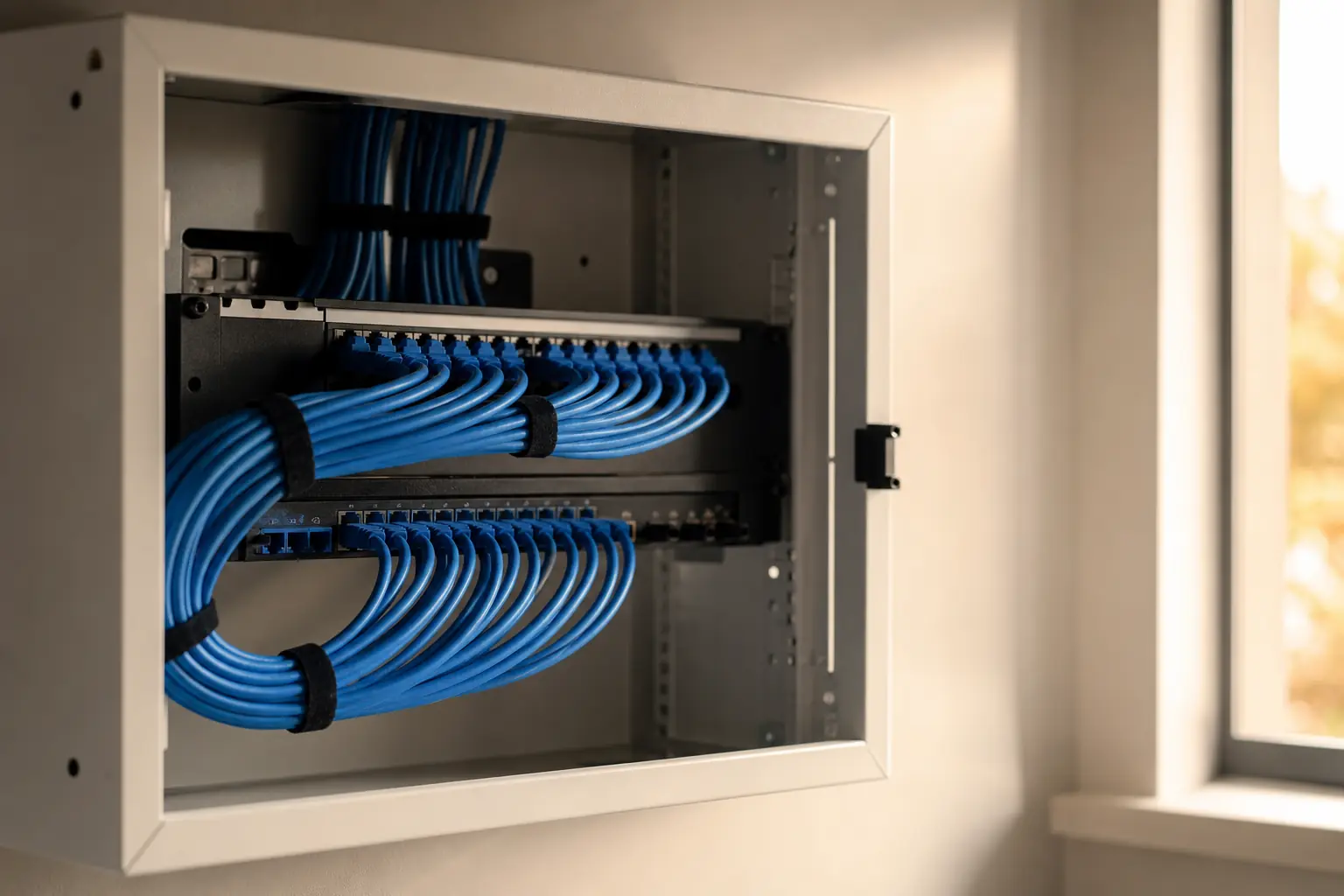
Home network wiring is a set of Ethernet cables that run from a central point in the house to outlets in the rooms where you need a connection. Each cable carries internet and data to one device or one access point. When it is planned well, it is invisible, and it works without attention for years.
N. Abeyta Remodels is a licensed and insured remodeler based in Brentwood. We install network wiring for homeowners in Brentwood and the East Bay, most often during a remodel when the walls are open. Estimates are free, and one team manages the work with the other trades.
Why wired beats wireless for fixed devices
Wifi is convenient, but it shares airtime, loses strength through walls and floors and varies with distance and interference. A cable does not share, fade or drop. Anything that stays in one place is better on a cable: TVs and streaming boxes, desktop computers, game consoles, printers, security cameras and the access points themselves.
Moving fixed devices to cable also helps the wifi. Phones and laptops get more of the wireless capacity when the heavy users are plugged in.
Structured wiring and the central point
Structured wiring means every cable runs back to one location instead of daisy-chaining room to room. That point holds the incoming internet connection, the router and the switch that distributes the cables. Home runs make troubleshooting simple, since each room has its own line, and they let you change equipment without rewiring.
- Central locationA closet, utility space or garage wall that has power, ventilation and room for equipment. Heat and dust shorten equipment life, so we avoid cramped, hot spots.
- Home runsOne cable per outlet, each running back to the central point, labeled at both ends.
- OutletsData jacks placed where furniture and screens will actually be, not just where it is easy to drill.
- Spare capacityA few extra runs or empty conduit cost little during construction and are expensive later.
Access point placement
One router in a corner rarely covers a whole house. A better plan is wired access points placed where coverage is needed. Each is usually mounted high, near the middle of the area it serves, with a cable running back to the central point. Walls, floors, mirrors, large appliances and metal ducting weaken signal, so placement is thought through room by room.
A two-story or long, narrow house often does better with more than one access point on cable than with one powerful unit. We help you choose the locations, and the cable goes in during the remodel so the mounting spots are ready.
How it is coordinated with a remodel
The best time to run cable is after demolition and before drywall. With studs exposed, cable can be routed cleanly, kept away from high-voltage lines and stapled loosely so it is not pinched. Fishing cable later means cutting holes, patching and repainting.
That is why network planning belongs in the remodel plan. We decide outlet locations alongside electrical work, so data and power boxes are placed together, and we finish before drywall closes the walls. Cable should cross power wiring at right angles where it must and stay separated from it elsewhere, because interference can degrade a connection.
What goes wrong when it is done badly
- Cable bent sharply, pinched by staples or pulled tight can cause intermittent drops that are hard to trace.
- Cable laid beside power lines for long runs can pick up interference.
- Poor terminations at the jack are a common cause of slow or unstable connections.
- Unlabeled cables turn simple changes into guesswork.
- No spare runs means exposed cables along baseboards when needs change.
Permits and licensing
Low voltage and data wiring can fall under its own licensing and permit rules, which vary with the scope and the type of work. We confirm what applies to your project and your address before we start, and we bring in the right trade when needed.
What happens, in order
- Walkthrough. We talk through how you use the house, where screens and desks go and where wifi is weak. Estimates are free.
- Plan. We set outlet and access point locations and the central equipment point.
- Rough wiring. Cable is run through open framing and labeled.
- Inspection of runs before drywall. We check every run is in place before walls close.
- Trim. Jacks and plates go on after drywall and paint.
- Test and walkthrough. Each run is tested, and we go over the layout with you.
What affects price and schedule
The number of runs, the distance to the central point, access through framing, attics or crawlspaces, and whether walls are open or finished decide the work involved. Retrofitting into finished walls takes more time than wiring an open remodel. We do not quote figures before seeing the house, and at the free estimate we give you a scope you can compare.
Where we work
We install network wiring in Brentwood, Antioch, San Ramon and Livermore, and across the East Bay. See the full service area. For smaller fixes around the house, see our handyman services.
Home network wiring questions
Why run Ethernet cable when I have wifi?
Cable gives a steady connection that does not depend on walls, distance or neighbors' signals. It suits TVs, desktop computers, game consoles and access points, and it leaves wifi capacity for phones and laptops.
When is the best time to add network wiring?
During a remodel, while the walls are open. Running cable through open framing is far easier than fishing it through finished walls, and it avoids extra drywall repair.
Where should the wifi access point go?
Usually near the center of the area it serves, high on a wall or ceiling, away from large metal objects. A wired connection to each access point makes the signal far more reliable than relying on wireless links.
Do I need a licensed contractor for low voltage wiring?
It depends on the work and your location. We confirm the requirements for your project and bring in the right trade when needed.
How many cable drops should I plan?
More than you think you need today. We walk the house with you, think about where TVs, desks and access points might go, and add a few spare locations since the cost of an extra run is lowest while the walls are open.
Which areas do you serve?
Brentwood, Oakley, Antioch, Concord, Pleasant Hill, Walnut Creek, Alamo, Danville, San Ramon, Pleasanton, Livermore, Tracy and Discovery Bay.
Ready to plan your home network?
Free estimates for homeowners in Brentwood and the East Bay.