
Guide
How to choose flooring
Pick the floor by the room it will live in, not by the sample in your hand. Moisture, wear, the subfloor and how it will be installed matter more than the look.
The short answer
To choose flooring, start with the room and what happens in it. Wet rooms such as bathrooms, laundry rooms and entries favor tile or vinyl. Living areas and bedrooms suit hardwood, laminate or vinyl. Kitchens can go either way, depending on how much you trust yourself and your household to wipe up spills. After the room, think about the subfloor, how long you plan to stay, and how the floor will meet the surfaces next to it.
Start with the room
Water is the main thing that separates good flooring choices from bad ones. Ask three questions about each room:
- Will water reach this floor regularly, or only in a spill or a leak?
- How much foot traffic, grit and furniture dragging will it take?
- Is the floor on a slab, over a crawl space or upstairs?
The answers narrow the list fast. A hall bathroom with kids in the tub is a different problem from a quiet guest bedroom.
Hardwood
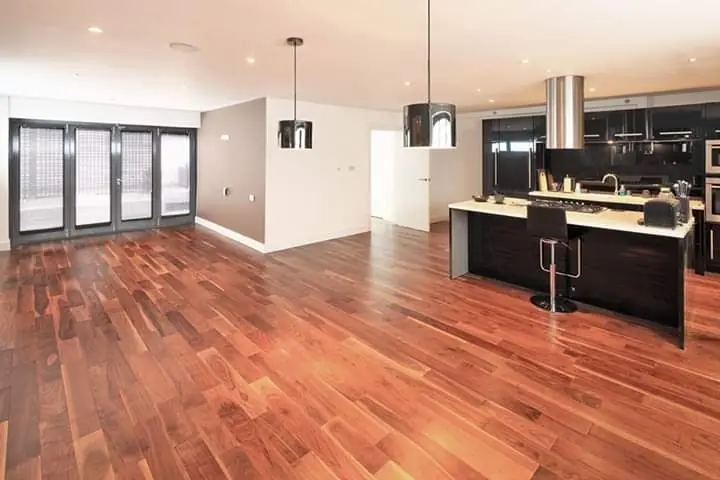
Solid hardwood is nailed or glued to a wood subfloor and can be sanded and refinished more than once. That is its main advantage: a worn floor can be renewed rather than replaced. It reacts to humidity and to standing water, so it is a poor fit for bathrooms and a risk near sinks, dishwashers and refrigerator water lines. Engineered hardwood has a real wood surface over layered backing and is more stable. It can handle more kinds of installation, but the wear layer limits how often it can be refinished. Over a concrete slab, moisture in the slab has to be dealt with first.
Laminate
Laminate is a printed surface over a fiberboard core, usually installed as a floating floor that clicks together. It is a practical way to get a wood look, goes down quickly and does well against scratches. Its weakness is water at the seams and edges: once the core swells, it does not go back. Choose it for bedrooms, offices and living areas, and be wary near sinks and entries. It cannot be refinished, so a damaged area means replacing planks.
Vinyl plank and sheet vinyl
Modern vinyl plank is waterproof at the surface and comes in wood and stone looks. It handles kitchens, bathrooms, laundry rooms and basements well. A good installer will still care about the subfloor: vinyl is thin, and bumps, ridges or gaps underneath can telegraph through. Thicker, firmer products hide more. The trade-off is that it dents under heavy point loads and cannot be refinished, so repairs mean swapping planks. Quality varies a lot between products, so ask to see and handle samples.
Tile
Porcelain and ceramic tile are the standard for wet areas, and they last. They are also unforgiving. Tile needs a flat, rigid base, because a floor that flexes cracks tile and grout. Setting it right takes prep, mortar and cure time, and grout lines need sealing or a grout that does not need it. It feels cold and hard underfoot, and dropped dishes rarely survive. Our tile contractor page covers how tile jobs run, and for showers and walls see the bathroom remodeling page.
Comparing the four by room
| Room | Best fits | Use with care |
|---|---|---|
| Bathroom | Tile, vinyl | Hardwood, laminate |
| Kitchen | Tile, vinyl, engineered wood | Laminate near the sink and dishwasher |
| Entry and mudroom | Tile, vinyl | Hardwood and laminate |
| Living areas | Hardwood, laminate, vinyl | Tile if you want warmth |
| Bedrooms | Hardwood, laminate, vinyl | Tile |
| Laundry room | Tile, vinyl | Hardwood, laminate |
The subfloor decides how it turns out
Most flooring failures are not the material. They are the floor underneath. Before anything goes down, a good installer checks that the subfloor is flat, solid and dry. Squeaks get fixed. Soft spots get repaired. Low spots get leveled. If the house has had a leak, the cause is fixed before anything is covered up. Our plumbing leaks guide explains what to look for.
Transitions matter too. Different materials sit at different heights, and the pieces that join them should be planned before the work, not improvised at the end. Baseboards, door casings and cabinet toe-kicks all interact with flooring thickness, which is why it helps to choose the floor before ordering cabinets.
Where flooring fits in a remodel
In a kitchen or bathroom remodel, flooring usually goes in after demolition, rough plumbing and electrical, and wall repair, and before or after cabinets depending on the plan. Floors that run through several rooms look best when installed as one continuous surface. If you are planning more than one room, ask us to walk through the order. Our flooring service handles installation, and our kitchen and bathroom teams build it into the schedule. For more on picking materials, see best bathroom flooring materials and choosing kitchen cabinets and countertops.
Flooring: questions
What is the best flooring for a busy family?
Look for a hard surface that handles spills, scratches and dirt without fuss. Tile and good vinyl plank both do that. Hardwood and laminate can work too, but they ask more of you where water is concerned.
Which flooring handles moisture best?
Tile is the most water-tolerant choice, provided the grout is sealed and the floor under it is solid. Vinyl plank also copes well with spills. Hardwood and most laminate are the least forgiving where water sits.
Can new flooring go over the old floor?
Sometimes. Floating floors such as laminate and vinyl plank can often go over a sound, flat existing surface. Tile and nailed or glued hardwood need a clean, solid, flat base, so old flooring usually has to come up first.
Does the subfloor matter?
A great deal. Whatever you choose, a floor that is not flat, solid and dry will squeak, flex, crack or lift. Good installers check and correct the subfloor before any material goes down.
Should I choose flooring before or after cabinets and paint?
Choose it early, so cabinet and door heights can account for its thickness. Install order depends on the job, and your contractor should set it out in writing.
Planning new floors?
Call or send the form. We will look at the subfloor and talk through your options.